Bildon Steel Bildon Steel

10 Best Answers Why Condensation Forms on Steel Walls?

Time:2026-09-15 Author:Sophia
0%

Condensation on steel walls can look like rain trapped indoors. Small droplets gather around cold panels, bolts, seams, and uninsulated corners. The water may seem harmless at first. It can later damage insulation, promote corrosion, stain surfaces, and affect stored products.

The key question is: why does condensation form on steel building walls? Building-science principles provide a clear starting point. Warm, moisture-filled air meets a steel surface colder than the surrounding air. When that surface reaches the dew point, airborne vapor becomes liquid water. Poor ventilation, indoor humidity, thermal bridges, and missing insulation can make the problem worse. Even a clean, well-built wall can sweat under the right weather conditions.

This guide presents ten practical answers based on moisture control, thermal performance, and field inspection experience. It considers roof drainage, heating patterns, air leakage, coastal exposure, and daily temperature changes. A reliable diagnosis should measure indoor humidity and surface temperature, not rely on appearance alone. That matters.

A simple explanation can mislead. For example, blaming ventilation alone may ignore a compressed insulation layer or an unsealed wall joint. Steel buildings respond quickly to changing conditions, so condensation may appear before occupants notice discomfort. The following answers connect visible droplets with their likely causes, useful checks, and sensible prevention methods. Always verify conditions on site, because every building has different materials, climate, occupancy, and maintenance history.
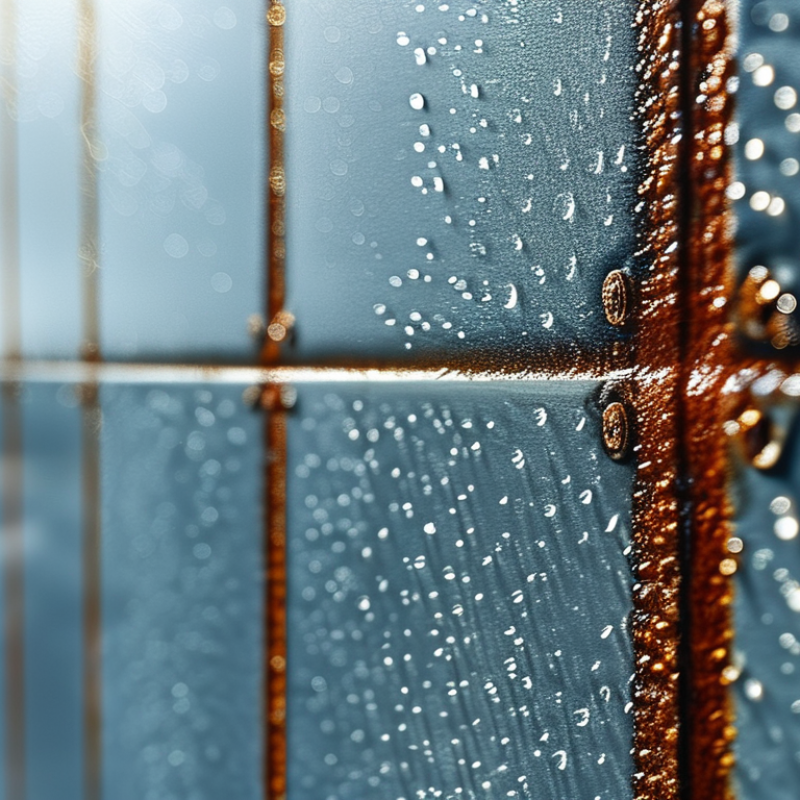
10 Best Answers Why Condensation Forms on Steel Walls?

Define Condensation: Air Moisture Forms Water Below Its Dew Point

10 Best Answers Why Condensation Forms on Steel Walls?

Condensation forms when humid air touches steel colder than its dew point. Dew point means the temperature at which air cannot hold all its moisture. Excess vapor becomes liquid water on the surface. It is not steel producing water.

For example, indoor air at 22°C and 60% relative humidity has a dew point near 14°C. If a steel wall falls below that temperature, small droplets can appear within minutes. The U.S. Environmental Protection Agency recommends keeping indoor humidity between 30% and 50%, and below 60% whenever possible, according to its moisture and mold guidance. ASHRAE Standard 55 also treats humidity as a key part of indoor comfort, although comfort limits do not automatically prevent condensation.

Steel cools quickly because it conducts heat efficiently. Exterior corners, fasteners, joints, and uninsulated sections can create colder thermal bridges. Warm air may then reach these spots through gaps, carrying invisible moisture with it. A surface thermometer and hygrometer provide better evidence than visual guesses. Check after rain, overnight cooling, and indoor activities such as cooking.

One detail is easy to miss. A dry room can still have condensation if the steel surface is extremely cold. Conversely, moderate humidity may cause no droplets on a well-insulated wall. The calculation helps, but it is not the whole diagnosis. Air movement, insulation quality, and hidden moisture deserve inspection. Field observations can be imperfect, especially when readings change during the day.

Check Indoor Humidity Against ASHRAE 55’s 30–60% Relative Humidity Range

Condensation forms on steel walls when warm, moist indoor air meets a colder metal surface. The steel may be below the air’s dew point, even when the room feels comfortable. Indoor humidity deserves close attention. ASHRAE 55’s commonly referenced comfort range is 30–60% relative humidity. Staying within this range can reduce moisture risk, but it cannot prevent every problem.

Ten practical answers often explain the droplets: high indoor humidity, poor ventilation, cold outdoor temperatures, missing insulation, thermal bridges, gaps around panels, wet construction materials, blocked airflow, indoor drying activities, and inaccurate humidity readings. A small steel corner can become much colder than the room average. That detail matters.

Measure humidity near the wall, not only beside the thermostat. A hygrometer reading of 65% signals increased risk, especially during winter. Steam from showers, boiling water, and drying clothes can raise moisture quickly. Run exhaust ventilation during these activities. Keep furniture slightly away from the steel surface. Air movement helps.

I once trusted a single meter and missed a colder wall section. That was a useful mistake. Surface temperature testing gives better evidence. If indoor air is 20°C and the steel surface falls near its dew point, water can appear within minutes. Lowering humidity toward 50%, improving insulation, and sealing air leaks usually works better than wiping droplets repeatedly. The wall may look dry while corrosion has already started behind a coating.

Trace Steel Wall Cold Spots Using Steel’s 45–60 W/m·K Thermal Conductivity

10 Best Answers Why Condensation Forms on Steel Walls?

Steel walls rarely condense moisture without a temperature reason. Steel conducts heat at roughly 45–60 W/m·K, so cold areas spread quickly across the panel. A small thermal bridge can therefore create a surprisingly cold surface.

Condensation begins when the steel surface falls below the room’s dew point. Humid indoor air may come from cooking, washing, drying clothes, or poor ventilation. Unsealed joints, missing insulation, metal fasteners, and compressed insulation can produce visible cold spots. External wind, shaded wall sections, and sudden night-time temperature drops can deepen the problem. Even a thin water film matters.

I inspect these walls with a surface thermometer, humidity meter, and infrared camera. The camera often reveals dark strips around seams, corners, and penetrations. However, an infrared image is not proof by itself. My first inspection once blamed weak insulation, but air leakage behind the lining caused the colder pattern. That mistake changed my method. I now compare surface readings with room dew point and inspect both sides of the wall. Look for damp insulation, rusty fasteners, peeling coatings, and water marks below joints. Improving ventilation may reduce humidity, but it cannot correct a steel bridge. Continuous insulation, sealed penetrations, and controlled indoor moisture usually provide a more durable repair. Some assessments remain uncertain until conditions change. Rain, heating cycles, and occupied rooms can reveal different evidence.

Assess Insulation and Thermal Bridges Under ISO 13788 Surface-Temperature Principles

Condensation on a steel wall is usually a temperature problem before it is a water problem. Warm indoor air reaches a cold steel surface, and moisture becomes droplets. Ten practical answers usually involve missing insulation, thermal bridges, air leakage, high humidity, or poor drainage. Exterior temperatures below freezing make these weaknesses easier to see.

ISO 13788 surface-temperature principles help assess this risk. The key check is the internal surface temperature factor, fRsi. It compares the wall’s inside surface temperature with indoor and outdoor temperatures. A low value indicates a colder surface and a greater mould or condensation risk. Designers should compare the calculated surface temperature with the indoor dew point, not rely on insulation thickness alone.

Steel studs, fasteners, corners, joints, and service penetrations often create narrow cold lines. On site, I have seen condensation follow a screw pattern across an otherwise insulated wall. A thermal camera may reveal this pattern, but it cannot replace moisture readings or construction records. Insulation must remain continuous, dry, and tightly fitted. Air barriers also matter because leaking warm air can carry moisture into hidden cavities.

A simple calculation can mislead. ISO 13788 uses defined climate and humidity assumptions, while real buildings experience cooking, occupancy changes, wind, and sudden heating. Check indoor relative humidity near the wall, especially after overnight cooling. One overlooked joint can outweigh a large insulated area. Structural movement may also reopen seals that looked sound during installation.

10 Best Answers Why Condensation Forms on Steel Walls? — Assess Insulation and Thermal Bridges Under ISO 13788 Surface-Temperature Principles
No. Likely Cause How Condensation Forms Typical Field Clue Useful Check Illustrative ISO 13788 Indicator Recommended Action Priority
1 Insufficient continuous insulation Steel has high thermal conductivity, so an inadequately insulated panel rapidly transfers indoor heat to the exterior. The interior steel surface can fall below the indoor-air dew-point temperature. Condensation appears across broad areas of the wall during cold weather. Measure indoor air temperature and relative humidity, then measure the internal steel-surface temperature with a calibrated contact or infrared method. Example: 20°C indoor air and 60% RH produce a dew point of approximately 12°C. A surface below 12°C is at risk of visible condensation. Increase the effective thermal resistance with continuous, correctly installed insulation. Seal joints and avoid compressed or missing insulation. High
2 Thermal bridges at studs, girts, rails, or fasteners Metal framing members bypass insulation and create localized cold surfaces. Surface temperature may be acceptable in the insulated field but inadequate along the metal line. Condensation or dark staining follows straight vertical or horizontal lines. Use thermal imaging during a suitable indoor–outdoor temperature difference and compare the metal-framing pattern with construction drawings. Surface-temperature factor: fRsi = (θsi − θe) ÷ (θi − θe). Lower values indicate colder internal surfaces. Reduce repeating thermal bridges with thermally improved framing, thermal-break components, continuous insulation, or improved fastening details. High
3 Missing or displaced insulation at panel joints Gaps at vertical joints, corners, base details, or roof-to-wall junctions expose colder layers and create narrow condensation zones. Moisture is concentrated at panel seams, corners, and transitions between wall systems. Open representative joints where permitted, inspect insulation continuity, and check for visible gaps, compression, or slumping. Local surface risk: a small cold spot can reach the dew point even when the average wall U-value appears acceptable. Restore insulation continuity, close construction gaps, and use durable airtight and weather-resistant joint detailing. High
4 Indoor relative humidity is too high Higher relative humidity raises the dew-point temperature. A steel surface that remains dry at 40% RH may condense at 70% RH under the same room temperature. Condensation increases after occupancy, washing, cooking, production, or other moisture-generating activities. Log indoor temperature and RH at several locations for at least several days, preferably during the coldest operating period. At 20°C: 40% RH gives a dew point of about 6°C; 60% RH about 12°C; 70% RH about 14°C. Control moisture generation, improve mechanical ventilation, repair exhaust systems, and use dehumidification where appropriate. High
5 Air leakage through the steel-wall assembly Warm, moisture-laden indoor air can enter joints or service penetrations and contact cold steel layers, producing concealed or surface condensation. Moisture is found near penetrations, sockets, junctions, or pressure-sensitive locations rather than uniformly across the wall. Conduct a visual airtightness inspection and, where suitable, a pressure test with smoke or tracer methods. Principle: ISO 13788 surface-temperature checks do not replace an airtightness assessment; air transport can deliver more moisture than diffusion alone. Repair the continuous air-control layer, seal penetrations, and ensure joints are compatible with expected movement and temperature cycling. High
6 Cold corners, wall-to-floor, and wall-to-roof junctions Two-dimensional heat flow at geometric junctions reduces the internal surface temperature compared with the center of the wall. Mould, rust, or water droplets occur at corners and perimeter junctions first. Scan junctions with thermal imaging and verify that insulation and air-control layers remain continuous through the detail. Local fRsi: evaluate the junction surface temperature rather than relying only on the wall’s one-dimensional U-value. Redesign or retrofit the junction with continuous insulation, insulated edge components, and airtight corner detailing. High
7 Indoor air is stagnant near the steel wall Low air movement reduces heat transfer from room air to the wall surface. The local surface becomes colder while moisture accumulates near the boundary layer. Condensation is worse behind stored goods, shelving, partitions, or equipment placed close to the wall. Check clearance from the wall, air circulation routes, and temperature differences behind obstructions. Boundary condition: surface-temperature calculations depend on internal surface resistance; blocked airflow can make the local condition colder than the assumed average. Maintain a practical air gap, remove obstructions, improve circulation, and avoid placing moisture-sensitive materials directly against the steel wall. Medium
8 Exterior water ingress or failed weather seals Rainwater entering through failed cladding joints, flashings, or penetrations can wet insulation and steel. Wet insulation loses thermal performance and increases corrosion risk. Moisture is linked to rainfall, wind exposure, sealant failures, or localized staining below openings. Inspect external joints, flashings, penetrations, and drainage paths; compare moisture findings with recent weather conditions. Important limitation: ISO 13788 steady-state surface-temperature principles do not diagnose rain penetration or all transient moisture events. Repair the external water-shedding layer, replace failed seals, improve flashings, and dry or replace persistently wet insulation. High
9 Cold outdoor conditions or intermittent heating When outdoor temperature drops or indoor heating is reduced, the steel surface temperature falls quickly because steel has low thermal mass and high conductivity. Condensation occurs mainly at night, during shutdowns, or during sudden outdoor temperature changes. Log indoor and outdoor temperatures, RH, and steel-surface temperature during the complete heating cycle. Example: with 20°C indoors and −5°C outdoors, a surface temperature of 10°C is below the dew point for indoor air at 60% RH. Maintain stable heating, reduce indoor moisture during shutdowns, and improve insulation or thermal-break performance at vulnerable areas. Medium
10 Corrosion, coating damage, or trapped moisture at the steel surface Corrosion products and damaged coatings can retain moisture. Rust also indicates that the steel has experienced repeated wetting, even if droplets are not present during inspection. Rust spots, blistered paint, white deposits, or damp insulation are visible around fixings and laps. Measure steel moisture conditions where possible, inspect coating adhesion, and determine whether moisture is from condensation or water ingress. Assessment rule: surface-temperature analysis identifies condensation potential but does not determine coating durability or corrosion severity. Remove the moisture source, clean and protect the steel using a compatible corrosion-control system, and replace severely deteriorated components. High
Assessment note: ISO 13788 uses temperature and humidity relationships to assess surface condensation and mould-growth risk under defined boundary conditions. The method is mainly a steady-state screening approach; detailed diagnosis may also require airtightness testing, rainwater investigation, thermal-bridge modelling, and transient hygrothermal analysis.

Rank Ten Causes: Leaks, Ventilation, Heating, Coatings, and Outdoor Conditions

10 Best Answers Why Condensation Forms on Steel Walls?

Condensation forms when warm, moisture-filled air meets steel below its dew point. The practical ranking is: 1) air leaks, 2) poor ventilation, 3) cold outdoor conditions, 4) insufficient heating, 5) thermal bridges, 6) failed insulation, 7) high indoor humidity, 8) plumbing or roof leaks, 9) non-breathable coatings, and 10) wet materials stored nearby. Steel reacts quickly because it conducts heat efficiently. CIBSE Guide A identifies surface temperature and humidity as central condensation controls. The U.S. Environmental Protection Agency recommends indoor relative humidity between 30% and 50%, when practical.

Air leakage often carries damp indoor air behind panels or around fasteners. Poor extraction in workshops, kitchens, and wash areas makes the problem worse. Outdoor temperature matters too. A freezing wall may remain cold after indoor heating starts, creating beads near corners and joints. Heavy coatings can hide corrosion and trap moisture, although coatings are not always the original cause. A damaged roof, pipe, or seal can look exactly like condensation. This ranking is useful, not perfect; site testing can change it.

Tips: Measure humidity and steel surface temperature at the same time. Compare the readings with the dew point using a calibrated meter. Check corners, welds, bolts, and panel overlaps first. Improve extraction, repair leaks, and warm cold surfaces gradually. Do not simply repaint wet steel. ASHRAE Handbook—Fundamentals advises evaluating moisture movement, insulation continuity, and surface temperature together.

FAQS

What causes condensation on a steel wall?

Warm, humid air touches steel colder than its dew point. Water droplets then form. The steel does not create water.

What is the dew point?

The dew point is the temperature where air cannot hold more moisture. Extra vapor becomes liquid. It may happen within minutes.

Can a comfortable room still produce condensation?

Yes. Indoor air at 22°C and 60% humidity has a dew point near 14°C. A colder steel panel may collect droplets despite comfortable air.

Which indoor activities increase condensation risk?

Showers, cooking, boiling water, and drying clothes release moisture. Steam can reach a cold wall quickly. Ventilate during these activities.

Where do steel walls usually become coldest?

Check corners, joints, fasteners, panel gaps, and uninsulated sections. These areas can form thermal bridges. Small cold spots matter.

How can I check whether condensation is likely?

Measure humidity near the wall with a hygrometer. Use a surface thermometer on the steel. Compare both readings with the dew point.

What humidity level helps reduce condensation?

Keeping indoor humidity near 30% to 50% usually lowers moisture risk. Levels above 60% deserve attention. Lower humidity cannot fix severe cold bridging.

Will wiping the droplets solve the problem?

Wiping removes visible water temporarily. It does not correct air leaks, missing insulation, or high humidity. Rust may already exist behind a coating.

How can condensation on steel walls be reduced?

Improve ventilation, seal panel gaps, and add continuous insulation. Keep furniture slightly away from the wall. Air needs room to move.

Can inspection results be misleading?

Yes. One humidity reading may miss a colder wall section. I once blamed weak insulation, but hidden air leakage caused the pattern. Conditions change after rain and overnight cooling.

Conclusion

Why does condensation form on steel building walls? It occurs when warm, moisture-filled indoor air meets a steel surface that is colder than the air’s dew point. Steel conducts heat rapidly, typically around 45–60 W/m·K, so cold spots can develop quickly, especially where insulation is thin, compressed, missing, or interrupted by thermal bridges. Indoor relative humidity should also be checked against the ASHRAE 55 range of 30–60%, since excessive moisture greatly increases the risk of surface water.

A practical assessment should consider ten common causes: air or roof leaks, inadequate ventilation, high indoor humidity, insufficient heating, poor insulation, thermal bridges, unsealed joints, cold outdoor weather, unsuitable or damaged coatings, and blocked airflow near the wall. Surface temperatures and moisture movement can be evaluated using ISO 13788 principles. Improving insulation continuity, controlling humidity, repairing leaks, increasing ventilation, and maintaining steady heating can reduce condensation and help protect steel walls from corrosion and related damage.

Sophia

Sophia

Sophia is a dedicated marketing professional with an exceptional depth of knowledge about her company's products and services. With a keen understanding of market trends and customer needs, she crafts insightful blog posts that not only inform but also engage readers, enriching the company’s online......