Bildon Steel
Choosing steel for a warehouse frame, roof panel, or precision bracket requires more than comparing price tags. The question “what is the difference between hot rolled and cold formed steel” begins with manufacturing temperature, forming method, and final application. Hot rolled steel is shaped above its recrystallization temperature. It usually has rounded edges, wider dimensional tolerances, and a scaled surface. Cold formed steel is shaped at room temperature, often from thin sheet or strip. It commonly delivers sharper corners, tighter tolerances, and higher local strength.
Metallurgist John D. Verhoeven offers a useful principle: “The properties of steel depend on its composition and its processing.” That statement keeps the comparison grounded. Processing changes more than appearance. It can influence residual stress, surface finish, springback, ductility, and fabrication behavior. A cold formed stud may fit neatly into a light-gauge wall assembly. A hot rolled beam may better suit a heavily loaded column. Real projects are less tidy, though. “Cold formed” does not always mean “cold rolled.” These terms describe different operations and should not be treated as interchangeable.
This guide examines the practical differences between both steel categories. It considers strength, tolerances, surface condition, welding, cost, corrosion protection, and design limitations. Expect useful details, not a perfect winner. A smooth cold formed profile can still fail when its thickness is inadequate. A rougher hot rolled section can remain the safer choice under demanding loads. Engineers should verify grades, thicknesses, standards, and supplier data before selecting material. Small details matter. A caliper, mill certificate, and clear load calculation can prevent expensive assumptions.
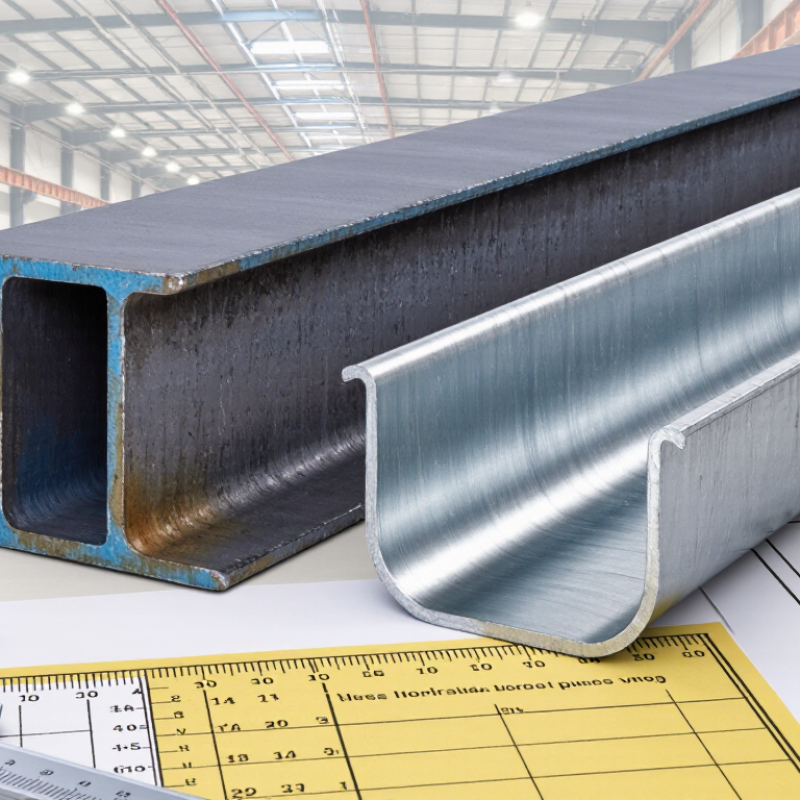
Hot rolled steel is shaped while heated above its recrystallization temperature. The process makes large beams, plates, channels, and thick bars easier to produce. Heat leaves a visible mill scale on the surface. Edges may look slightly rounded, and dimensions can vary more after cooling. I have seen this material arrive with a rough texture that needs cleaning before painting.
Cold formed steel starts as sheet or strip and is shaped near room temperature. Rollers or press brakes create channels, studs, tracks, and precise sections. No reheating occurs during forming. The surface usually looks smoother and dimensions are more consistent. However, bending can create residual stress and springback. Designers must also check local buckling in thin walls.
The main difference is not simply appearance. Hot rolled steel suits heavy structural members and demanding loads. Cold formed steel offers lighter profiles and efficient material use. Forming can increase strength around bends, but it may reduce ductility in those areas. That detail is easy to overlook. In professional practice, engineers compare thickness, yield strength, section shape, corrosion protection, and connection methods. Mill certificates and measured dimensions should support the selection. A quick visual check helps, but it is not enough. Temperature history, cooling behavior, and forming direction can change performance. The “best” material depends on the section and service conditions.
This chart compares representative minimum mechanical properties for ASTM A36 hot-rolled steel and ASTM A1003 Grade 50 cold-formed structural steel. Cold forming generally provides higher specified yield strength, while actual properties vary by grade, thickness, and manufacturing standard.
2026 Best Hot Rolled vs Cold Formed Steel Differences
Hot rolled steel begins as a heated billet, usually above its recrystallization temperature. Large rollers reduce its thickness and shape while the steel remains hot. After cooling, the material may develop a dark oxide scale. Its edges and dimensions can vary slightly.
Cold formed steel starts with sheet or strip at room temperature. Rollers or press brakes bend it into channels, angles, or complex profiles. No reheating occurs during shaping. The process improves dimensional accuracy and surface appearance. However, bending creates work hardening, residual stress, and springback. These effects can influence final fit.
In practical inspections, I have seen a cold formed flange return slightly after bending. It looked correct before release. That small movement caused alignment problems during assembly. Hot rolled sections can also surprise you. Mill scale may hide scratches or uneven cooling marks.
Tips: Check the production route, thickness tolerance, bend radius, and surface condition. Ask for test reports and confirm the applicable material standard. Measure sample parts after forming, not only before it. A clean finish is not proof of better performance. Design calculations should consider strength changes near bends, especially in thin sections. Some assumptions deserve another review.
| Comparison Dimension | Hot-Rolled Steel | Cold-Formed Steel | Practical Manufacturing Impact |
|---|---|---|---|
| Basic Manufacturing Route | Steel is shaped by rollers while it is above its recrystallization temperature, commonly around 900°C or higher depending on grade and process. | Steel sheet or strip is shaped at or near room temperature after hot rolling and, where applicable, pickling and coating. | Hot rolling enables large reductions and easier shaping; cold forming provides tighter dimensional control. |
| Starting Material | Typically begins with a continuously cast slab, billet, or bloom that is reheated before rolling. | Usually begins with hot-rolled and pickled coil that is further reduced, leveled, slit, or formed without reheating above the recrystallization range. | Cold forming is generally a downstream process rather than a completely separate steelmaking route. |
| Temperature During Shaping | High-temperature rolling reduces deformation resistance and allows heavy sections to be produced efficiently. | Room-temperature forming requires higher forming forces because the material is stronger and less ductile than before cold work. | Equipment capacity, tooling design, and production speed differ significantly between the two processes. |
| Typical Product Forms | Heavy plate, structural sections, rails, bars, wide strip, and large-diameter products. | Thin sheet, precision strip, tubes, channels, studs, tracks, panels, and other roll-formed profiles. | Product selection depends on required thickness, cross-section, surface quality, and dimensional precision. |
| Dimensional Accuracy | Good for structural products, but cooling and scale formation can produce wider dimensional tolerances. | Generally offers closer thickness, width, flatness, and profile tolerances. | Cold-formed products are often preferred when fit-up, repeatability, and profile consistency are important. |
| Surface Finish | Usually has a darker, rougher surface caused by mill scale formed during high-temperature processing. | Typically has a smoother and cleaner surface; the material may also be galvanized, electroplated, or otherwise coated. | Cold-formed steel is commonly selected for exposed, painted, coated, or appearance-sensitive applications. |
| Strength and Work Hardening | The final mechanical properties are mainly controlled through composition, rolling schedule, cooling, and heat treatment. | Plastic deformation increases yield strength and hardness through work hardening, while reducing some available ductility. | Designers must account for the stronger but potentially less formable condition of cold-worked material. |
| Ductility and Formability | Generally offers higher ductility during subsequent forming, especially when supplied in a suitable annealed or normalized condition. | Can have reduced ductility after forming because of accumulated cold work; bend radii and forming limits must be considered. | Severe reshaping is usually easier before extensive cold work has been introduced. |
| Residual Stress | Cooling across different section thicknesses can create residual stresses and shape variation. | Uneven deformation during roll forming or bending can produce residual stresses, springback, and local distortion. | Stress-relief, leveling, calibration, or improved tooling may be required for demanding applications. |
| Springback | Usually less pronounced during initial hot shaping because the steel is formed at elevated temperature. | More pronounced after bending or roll forming because elastic recovery occurs after the load is removed. | Cold-forming dies and roll passes must compensate for springback to achieve the target geometry. |
| Production Efficiency | Efficient for producing large volumes of heavy or thick steel products, but requires furnaces and high-temperature handling. | Efficient for continuous production of thin, uniform profiles, but normally involves additional processing after hot rolling. | Overall cost and efficiency depend on section size, production volume, tolerances, and finishing requirements. |
| Energy Requirements | Requires substantial energy for reheating and maintaining high rolling temperatures. | Avoids reheating the product to hot-working temperatures, although additional rolling forces and finishing operations are needed. | Energy comparisons should include the complete route, including pickling, annealing, coating, and forming. |
| Material Utilization | Suitable for near-net structural shapes, but trimming and scale removal may generate additional material loss. | Roll forming can create efficient lightweight profiles with high strength-to-weight ratios and relatively low scrap. | Cold-formed sections can reduce weight when geometry is optimized for the load path. |
| Common Joining and Finishing Needs | May require descaling, grinding, shot blasting, painting, welding, or other corrosion-protection steps. | May require welding, fastening, edge treatment, coating, or post-forming stress and shape checks. | Finishing requirements should be specified together with the steel grade and final service environment. |
| Typical Applications | Bridges, building frames, heavy machinery, rail infrastructure, pressure-related plate products, and large structural components. | Light-gauge framing, roofing and wall systems, automotive panels, electrical enclosures, storage systems, and precision components. | Hot-rolled products suit heavy-duty sections; cold-formed products suit precise, lightweight, and repetitive profiles. |
| Best Selection Criteria | Choose when heavy thickness, robust structural performance, high ductility, or large cross-sections are priorities. | Choose when close tolerances, smooth surfaces, efficient thin-wall geometry, or higher formed strength are priorities. | Neither process is universally superior; the correct choice depends on design loads, geometry, tolerances, finish, and budget. |
Hot rolled steel is shaped above its recrystallization temperature. This process makes large beams, plates, and thick sections practical and economical. Its strength is dependable, but cooling can leave slight dimensional variation. Corners may appear softer, and the surface often carries mill scale. That rough texture suits structural work, not every visible application.
Cold formed steel starts with room-temperature sheets or strips. Roll forming creates precise channels, studs, tracks, and complex profiles. The process can increase yield strength in bends through work hardening. However, thin sections may buckle if their shape or support spacing is poorly selected. I have seen drawings look adequate until actual loading exposed this weakness. Shape is not decoration; it controls performance.
Tips: Compare yield strength, thickness, tolerances, and finish requirements together. Request measured data, not only a catalog value. For exposed surfaces, allow for cleaning, coating, or galvanizing. Cold forming usually gives a cleaner finish, but handling can still create scratches. Hot rolled steel may need extra preparation before painting. A small design review can prevent an expensive mismatch. The best choice depends on load, geometry, appearance, and fabrication limits—not one material label alone.
Hot rolled steel suits heavy frames, bridges, columns, and industrial structures. It forms above the recrystallization temperature, creating robust sections with fewer shape restrictions. Cold formed steel is shaped at room temperature, usually from thin sheet. It works well for wall studs, roof purlins, floor joists, and modular construction.
The weight difference matters. The American Iron and Steel Institute’s Cold-Formed Steel Design Manual covers sections commonly produced from roughly 0.84 to 3.40 millimeters thick. These lighter members can reduce lifting demands and foundation loads.
However, thin sections need careful checks for local buckling, fastener pull-out, and corrosion exposure. Small mistakes become expensive quickly.
Costs are less obvious.
RSMeans Data 2025 shows that steel pricing varies significantly by region, labor availability, fabrication, and installation conditions. Cold formed steel may reduce transport and site labor costs, but it can require more connections and bracing. Hot rolled steel often costs more to handle, yet larger spans may simplify the frame.
The World Steel Association reported approximately 1.89 billion tonnes of crude steel production in 2023, confirming steel’s broad supply base. Still, availability is not guaranteed locally.
Designers sometimes overvalue material price and undervalue erection time. That comparison deserves another look.
2026 Best Hot Rolled vs Cold Formed Steel Differences
How to Choose Between Hot Rolled and Cold Formed Steel
Choosing between hot rolled and cold formed steel begins with the finished part, not the material price. Hot rolled steel is shaped above its recrystallization temperature. It suits beams, plates, brackets, and large welded components that tolerate wider dimensional variation. Its rough mill scale may require cleaning before painting or coating.
Cold formed steel is shaped at room temperature from sheet or strip. It offers tighter tolerances, cleaner edges, and efficient sections such as channels, studs, and hat profiles. Its thin walls can reduce weight, but local buckling needs careful checking. Small bends can also create residual stresses.
Look at the load path first. For a heavy frame exposed to impact, hot rolled sections often provide practical stiffness and easier fabrication. For a repetitive light-gauge assembly, cold formed sections may reduce handling time and material use. Check wall thickness, hole placement, connection design, and corrosion exposure together.
Do not compare only price per kilogram. A cheaper section may require extra welding, leveling, surface preparation, or bracing. That changes the real cost. In fabrication reviews, tolerance problems often appear at drilled holes and bolted joints. Measure the actual profile before final assembly when accuracy matters.
Ask the design engineer to verify capacity, deflection, fire requirements, and applicable standards. Review mill certificates and coating specifications. I would also question an early choice based only on habit. The first decision is sometimes wrong. Rechecking it can prevent expensive rework.
Hot rolled steel is shaped above its recrystallization temperature. It commonly forms beams, plates, channels, and thick bars. Heat leaves a dark mill scale. Its edges may appear slightly rounded.
Cold formed steel starts as sheet or strip near room temperature. Rollers or press brakes create channels, studs, tracks, and precise sections. No reheating occurs during forming. The surface usually looks smoother.
Hot rolled steel passes through rollers while it remains hot. It cools afterward, which can affect dimensions. Cold formed steel is bent without reheating. Springback may shift the final shape slightly.
Cold formed steel usually provides tighter dimensions and cleaner surfaces. Hot rolled steel may show greater variation after cooling. Measure actual parts. Appearance alone is not enough.
Cooling creates oxide scale on the surface. It may look dark, flaky, or uneven. Cleaning is often needed before painting or coating. I would not treat roughness as a defect automatically.
Engineers should check residual stress, springback, and local buckling. Thin walls can lose stability under compression. Bends may become stronger but less ductile. That detail is easy to miss.
Hot rolled steel often suits large members and demanding loads. Its thicker sections can provide substantial capacity. Cold formed steel may suit lighter, efficient profiles. The section shape still matters greatly.
Review thickness, yield strength, section geometry, corrosion protection, and connection methods. Check mill certificates and measured dimensions. Inspect bend radius and surface condition. I may recheck my assumptions.
Yes. A flange may spring back slightly after bending. That small movement can affect alignment during assembly. Measure parts after forming, not only before release. Small errors matter.
Hot rolled and cold formed steel are produced through different processes, and those differences affect their performance, appearance, and best uses. Hot rolled steel is shaped at high temperatures, making it easier to form into large or complex sections while generally offering a rougher surface and less precise dimensions. Cold formed steel is shaped at room temperature, which improves dimensional accuracy, surface smoothness, and the ability to create thin, detailed profiles. A common question is: what is the difference between hot rolled and cold formed steel? In simple terms, the answer lies in how each material is manufactured and how that process influences its characteristics.
Hot rolled steel is often selected for heavy structural components, industrial frames, and projects where strength and cost efficiency are priorities. Cold formed steel is commonly preferred for lightweight structures, precise sections, panels, and applications requiring design flexibility and a clean finish. Choosing between them depends on load requirements, shape complexity, dimensional tolerances, surface expectations, production volume, and budget. Understanding these factors helps designers select the most suitable steel for reliable and efficient results.
